In this story
A son of Niort, trained in Paris
Georges André Lasseron was born in Niort on 21 June 1844. The French National Institute for Art History records his training in Paris under Julien Guadet and his admission to the École des Beaux-Arts in 1873. Architects of the period were expected to master proportion, composition and the historical languages through which a building might express its purpose.
He worked outside his home town before returning to Niort and becoming its municipal architect. The title sounds administrative. The responsibilities were anything but dull. French provincial cities were expanding their schools, reshaping civic institutions and seeking buildings that could embody their ambitions.
Someone had to decide what a modern public institution should look like. Lasseron helped provide an answer.
The Republic dressed for the occasion
Niort's town hall, inaugurated in 1901, is the most conspicuous example. Its Renaissance Revival design gives a modern republican institution a language borrowed from the past. The Third Republic, it seems, had no objection to looking rather grand.
Sculpture and ornament celebrate such themes as commerce, agriculture, the sciences, the arts and education. It is architecture with a civic programme, not an exercise in discreet understatement.
Lasseron also worked on educational buildings. The former Jean-Macé girls' school, opened in 1897, now houses the Musée Bernard-d'Agesci. The school has become a museum, yet the building remains part of the town's daily life. That may be a more convincing form of endurance than preservation behind closed doors.
Municipal heritage records also associate Lasseron with a drawing school and several other school buildings. His work mattered to ordinary civic life as well as to ceremonial occasions.
Away from official architecture
Municipal duties did not prevent private commissions. Lasseron's work also included buildings connected with the savings bank and local commerce. At the turn of the twentieth century, projects such as the Grand Café and the shop known as À la Ménagère introduced a freer decorative language, with curves and coloured ceramics associated with Art Nouveau.
This range is instructive. A school, a town hall and a department store cannot reasonably wear the same architectural costume. Lasseron responded to different purposes rather than stamping a single motif on every commission.
His career is thus a good introduction to the eclecticism of his age: not necessarily a lack of conviction, but a willingness to choose the appropriate historical or decorative language for the job.
A house for Dr Roulland, in 1894
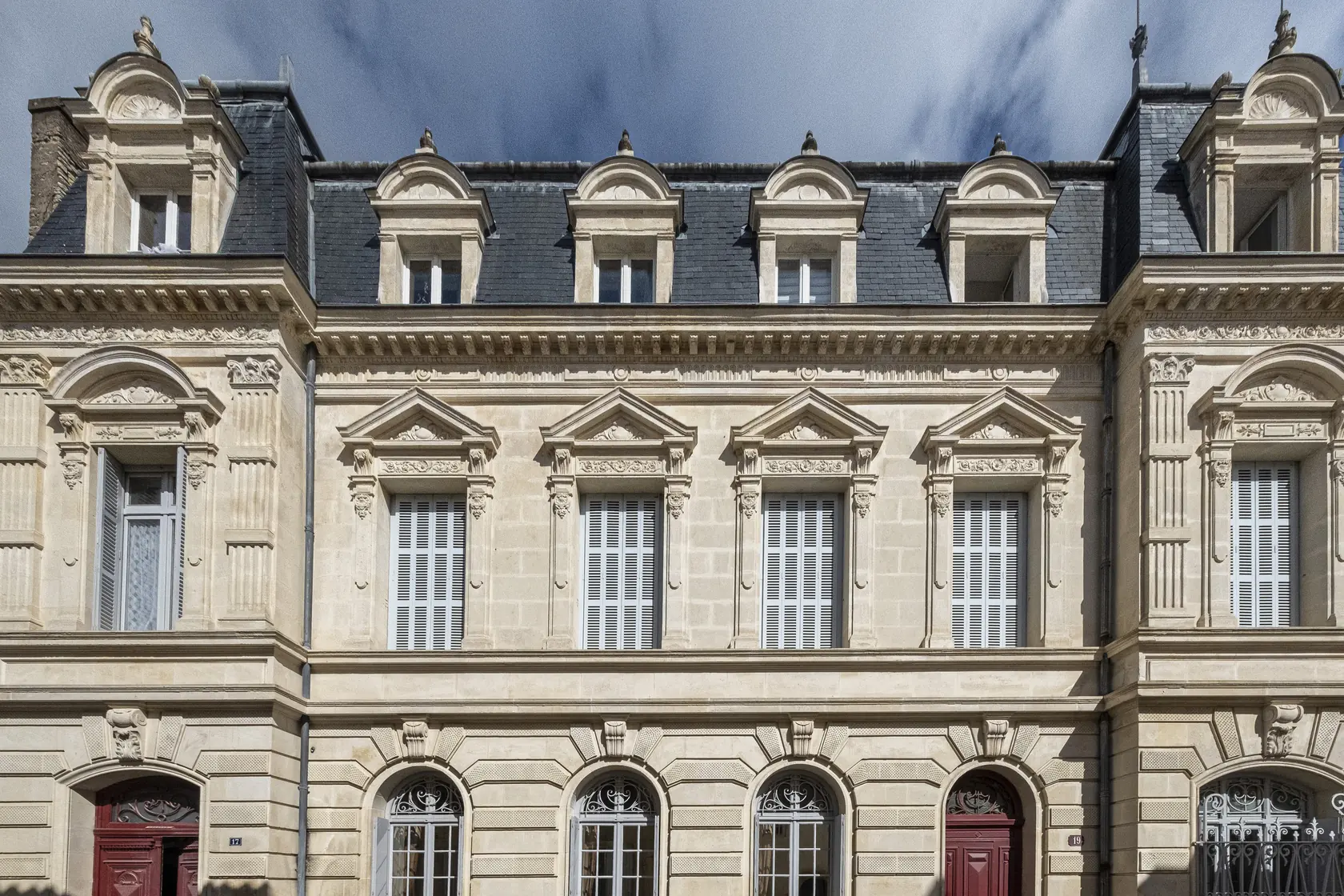
Among his private commissions was an hôtel particulier built in Niort in 1894 for Dr Albert Roulland. Interested in literature, music, archaeology and the arts, Roulland commissioned a residence whose Renaissance Revival exterior provided the setting for notably elaborate interiors.
A stained-glass window bearing the name of the Paris Champigneulle workshop lights the staircase. Jules Godefroy was commissioned to paint the principal salon in 1896. Mosaics and wood panelling complete the picture of a patron attentive to the decorative arts.
It would be misleading to attribute every ornamental decision personally to Lasseron. An ambitious home of this period was a collective enterprise, involving architect, patron and craftspeople. The surviving evidence does not assign every individual choice to a named hand.
The building is now divided into separate residences and continues to be lived in. Architecture, after all, is tested by the lives that follow its completion.
The city as an archive
Lasseron died in Niort in 1932. His work has undergone repairs, conversions and changes of use, as living buildings always do.
One can visit the Musée Bernard-d'Agesci, pass the town hall, notice a commercial façade and start to understand the late nineteenth-century city through its buildings rather than through a list of dates.
Great architects are often measured by exceptional monuments. For a municipal architect, a simpler question might suffice: does the city still use what he built? In Niort, the answer is written in its streets.