In this story
A work that is never quite the same twice
A passing cloud is enough to change a stained-glass window. In sunlight its colours take command; in dull weather they retreat. A painting remains in front of you. A window works with the weather. This makes life difficult for photographers and rather pleasant for anyone who lives beside it.
The nineteenth century brought stained glass into private interiors as well as churches. Staircases, entrance halls and winter gardens offered places where coloured panes could provide privacy, admit light and turn ordinary circulation into an architectural experience.
A staircase was no longer merely somewhere to get from one floor to another. It became somewhere worth looking around.
The Champigneulle workshops
The Champigneulle name belongs to a family history of French stained-glass making. Louis Charles Marie Champigneulle, known as Charles Champigneulle fils, established his Paris workshop in 1881 after an earlier connection with the family's activity in Bar-le-Duc.
Historic inventories document works associated with the workshop, particularly in religious buildings. But the appetite for decorative glass also extended to civic and domestic interiors. Glassmakers of the period combined drawing, painting, colour and exacting technical skills.
A swallow on a staircase in Niort
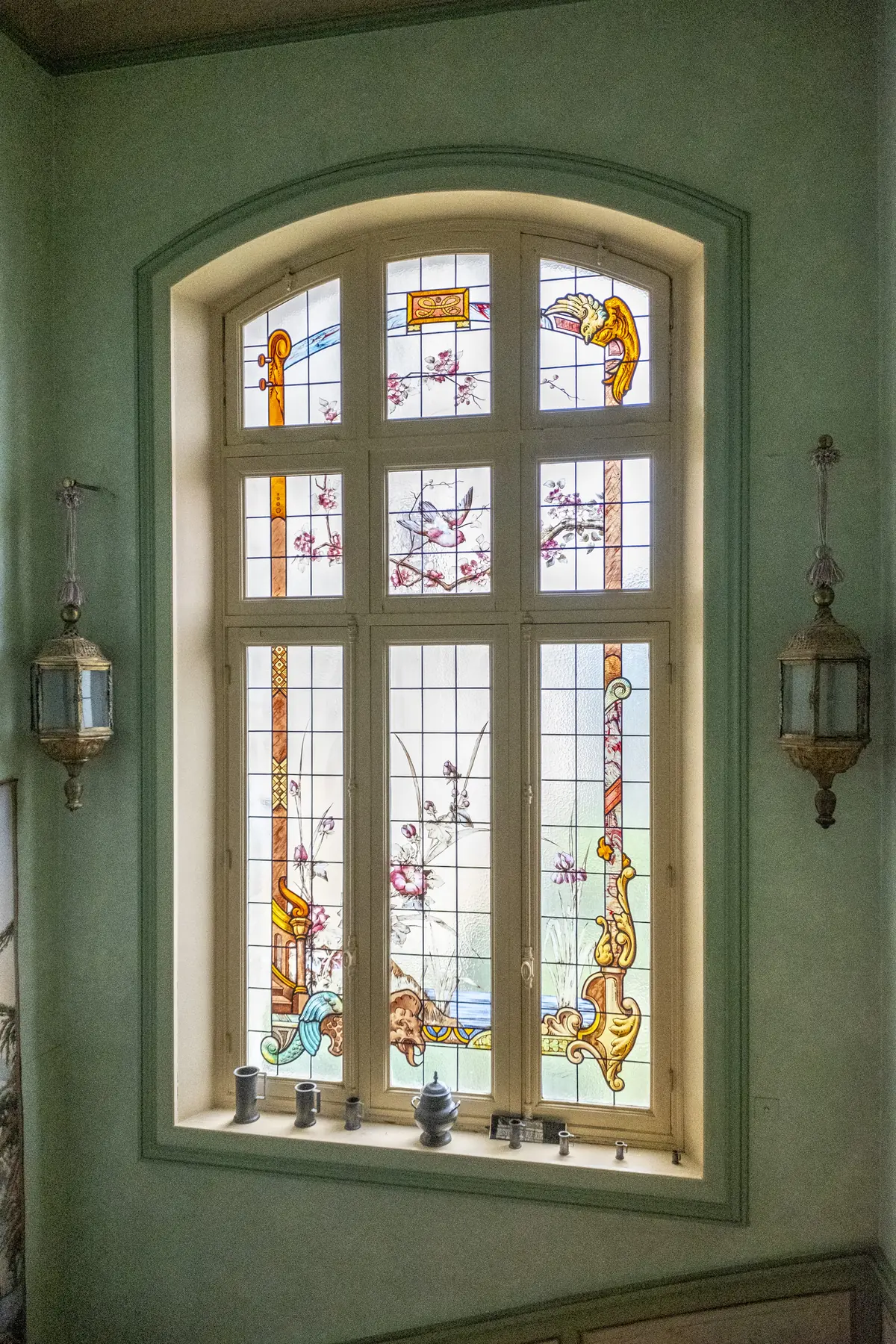
In an hôtel particulier built in 1894 for Dr Albert Roulland, a staircase window bears the signature “Ch. Champigneulle fils de Paris”, according to the family's documentation.
The photograph reveals a composition far removed from conventional religious scenes: a swallow in flight, flowering branches, delicate blossoms and colourful ornament. Scrolls and aquatic-looking shapes mingle with the vegetation. The designs spread across a tall window divided by its joinery.
Your eye rises towards the bird and then moves down through the curves and lower panels. This is not a heroic narrative. It is something quieter: a little of the garden, of movement and of the natural world brought indoors.
It would be easy to invent symbolism for every flower or to claim a private message in the swallow. Without the original commission or a written programme, such certainty would be theatrical rather than historical. The details themselves are quite enough.
The window belongs to its architecture
Stained glass cannot be understood apart from its setting. The frame, the direction of the daylight, the staircase and the divisions between the panes all influence what we see. Here, the window's vertical structure becomes part of the composition; the motifs answer one another across the individual sections.
That is why a close-up alone rarely tells the story. A view of the whole staircase, an image of the complete window and a clear photograph of the workshop signature would each show something different. The family photograph already offers the overall composition; the signature should be documented separately if it is to be reproduced as a detail.
Other decorated rooms survive in the same building. They have their own stories. This window deserves to be considered on its own terms: an object, a craft and a particular way of inhabiting light.
Fragile materials, enduring purpose
Leaded joints, painted glass and fixings age. An old stained-glass window cannot be repaired like an ordinary pane, and significant interventions call for specialist knowledge. Where a restoration history is unknown, it should not be invented.
More than a century after it was made, this window still performs its most modest and most remarkable task: it lights the stairs.
Perhaps that is the finest achievement of the decorative arts. They need not be removed from daily life to be admired. They remain part of it, hour by hour.